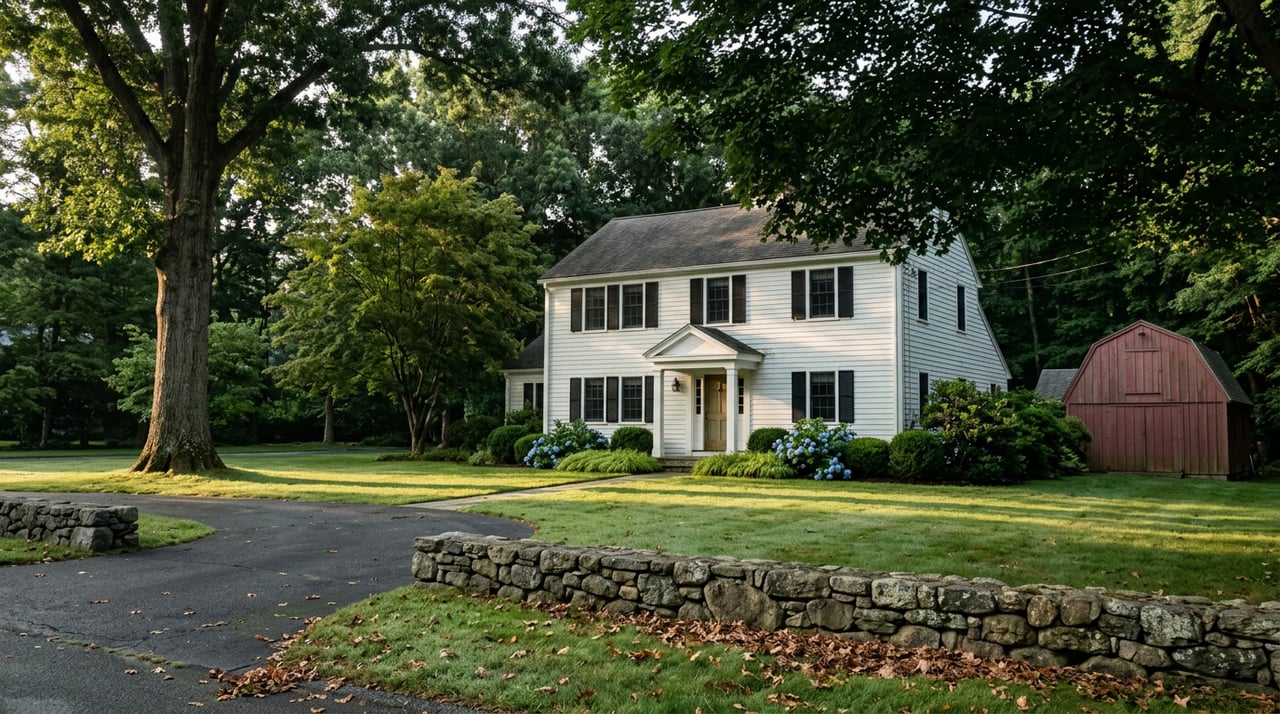
Drive through Westport and you hit a downtown. Wilton has its Town Green. Fairfield has Sconset Square and the strip along the Post Road. Weston has none of that, and it never did. Two-acre zoning and a conservation push a generation ago kept commercial development off the table, so there is no cluster of storefronts where residents naturally run into each other on a Saturday morning.
What Weston has instead is a single piece of town-owned land doing the job a downtown would otherwise do. Lachat Town Farm, a working farm on Godfrey Road West, has become the place where a market, a concert series, a communal dinner, a knitting circle and a sledding hill all happen in the same rough footprint, on a calendar built almost entirely by volunteers. If you want to understand how Weston gathers without a Main Street, this is where to look.
The Field Doing the Work of a Town Square
The farm's Friday markets run from June through the fall, and the next one lands on Friday, August 28, from 4 to 8pm. These aren't grab-a-tomato-and-leave errands. They come with food trucks, hearth-baked bread, local honey, and a rotating cast of small vendors, several of them Weston-based. Baked in Weston shows up with sourdough loaves fermented the traditional way, in flavors that run from plain white to walnut cranberry. Agape Premium brings single-origin Greek olive oil from family groves in Messinia. Honey Bee Flower Truck sets up with locally sourced bouquets. There's always live music, free, built into the market rather than an add-on.
The farm's own governing commission describes its mission as bringing residents together around a shared agricultural history, and its calendar backs that up. Beyond the Friday markets, Lachat runs a Music in the Meadow concert series, with dates on June 13, July 11, August 15 and a closing show on September 19. It hosts yoga and tai chi on Saturday mornings, a knitting circle on the third Wednesday of each month, and on Sunday, September 13, a community meal called the Longest Table that turns the farm's outdoor space into a single long dinner table for the town.
Here's the shape of what's left on the calendar this season:
| Event | Date | What it is |
|---|---|---|
| August Farmers Market | Friday, August 28, 4–8pm | Food trucks, produce, live music |
| Mandala Painting | Thursday, September 10 | Community art workshop |
| The Longest Table | Sunday, September 13 | Communal outdoor dinner |
| Music in the Meadow (final show) | Saturday, September 19 | Live concert, free |
A town with a commercial strip would spread this kind of programming across a dozen businesses competing for foot traffic. Weston concentrates it on one field, and the result is that showing up at Lachat on a given evening means showing up alongside whoever else in town decided to be there that night, whether they came for bread or for the band.
Two Preserves, Built the Same Way the Farm Was
The same pattern holds once you leave the farm and head into the woods, and it's not a coincidence. Weston's two major hiking preserves exist today because residents, at two different points decades apart, chose to buy the land rather than let someone else develop it.
Trout Brook Valley Preserve, reached from the Bradley Road entrance, was headed toward becoming a golf course and a cluster of luxury homes before the Aspetuck Land Trust stepped in. In 1999, the trust purchased the 730-acre property for $11.3 million, with financial backing from the state and thousands of local contributors, including the actor Paul Newman, who lived in nearby Westport. What resulted is a network of nearly 14 miles of trails that climb from the Weston side toward the Easton entrance, passing apple and blueberry orchards along the way. It reads less like wilderness and more like a working landscape that happens to be open to the public, which is close to what it once was.
Devil's Den, formally the Lucius Pond Ordway–Devil's Den Preserve, has a different origin and a different feel. It's the largest contiguous preserve in Fairfield County at 1,746 acres, created between 1966 and 1968 through a series of donations from Katharine Ordway, a longtime Weston resident who used part of an $18.8 million family inheritance to fund land conservation. Entered from Pent Road, the preserve carries 20 miles of trails past named features that give it a sense of place a generic nature loop doesn't have: Godfrey Pond, a mill pond dating to the 1700s; the Great Ledge, a rock outcrop with a wide view over the surrounding hills; and Ambler Gorge, a ravine where the stream drops over a rocky cascade. Despite its size, it draws about 40,000 visits a year, more foot traffic than a preserve twice as large in a less developed county would typically see.
Put the two side by side and the contrast is useful, not just scenic. Trout Brook feels cultivated, shaped by orchards and gentler grades. Devil's Den feels older and rougher, built around a watershed and named geological features rather than crops. Both exist because a private citizen decided the land was worth more as commons than as another subdivision, which is the same instinct that turned a working farm into the town's de facto gathering hall.
One Stretch of Road, Quietly Fixed
If you haven't driven Route 57 through Weston in a few weeks, it's smoother than it was in June. The Connecticut Department of Transportation ran a milling and resurfacing project on the corridor from the Westport town line up through Old Mill Road, then continuing along Georgetown Road to Trails End Road. Milling took place from June 22 to June 29, with paving running from July 9 through July 24. That work is finished now, which matters if your route to the farm's Friday market or to the Bradley Road trailhead runs along that stretch. It's a small thing, but it's the kind of small thing that changes whether the drive to either commons is a pleasant ten minutes or a bumpy detour.
The Pattern, Once You See It
None of this happened by accident. Weston kept its zoning at two acres and set aside roughly a third of its land for conservation a generation ago, a choice that ruled out the kind of commercial center other towns built around. What filled the gap wasn't nothing. It was a farm that residents turned into a market, a concert hall and a dinner table, and two preserves that residents bought outright rather than watch get developed. The town's public life runs on land that people here decided to keep, not land that came with a storefront already attached.
That's worth knowing if you already live here and have wondered why Weston never quite feels like its neighbors. It isn't missing a center. It just built one out of a field and a stretch of woods instead of a street.
If you're weighing a move within Weston, curious how a specific pocket of town is trending, or just want a second opinion from someone who reads this market closely, reach out to Jillian Klaff Homes to request a personalized market consultation.